When we meet
| First Sunday | Family Service | 9.30am |
| Third Sunday | Family Communion | 9.30am |
A few times a year, when a month has a fifth Sunday, the whole benefice gathers for one Communion, taking turns to host. See the whole month.
Gallery
More pictures from all six churches are in the benefice gallery.
About the church
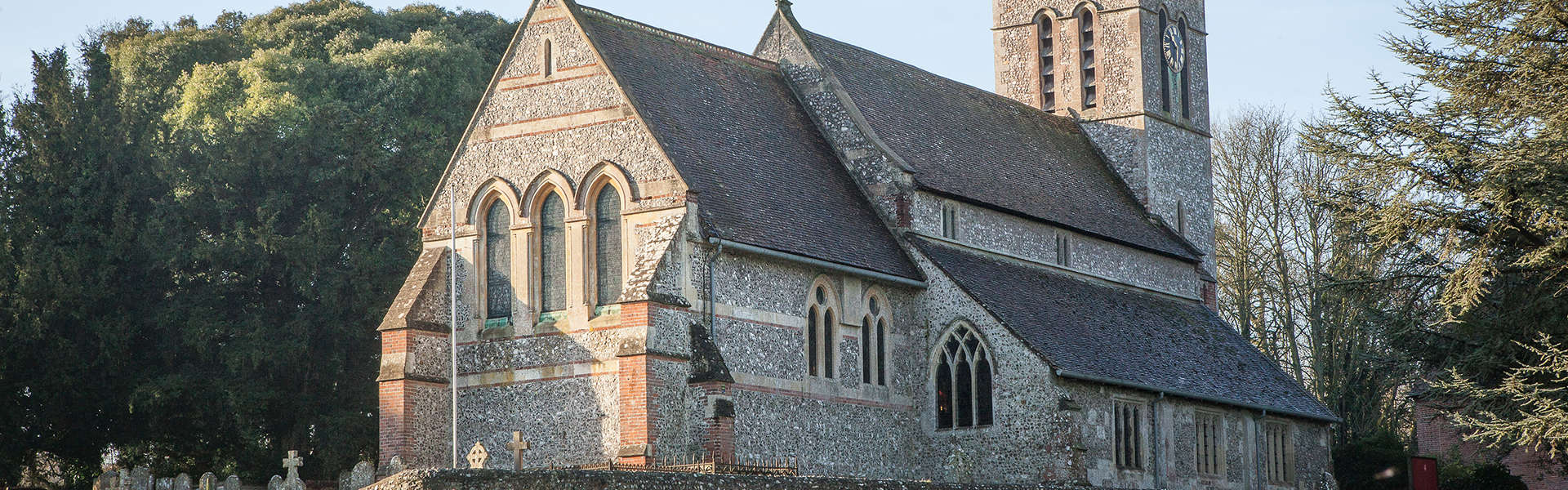
There has almost certainly been a church on this ground since Saxon times. The Domesday survey records that the estate held by Countess Gueda, wife of Earl Godwin and mother of King Harold II, included “a chapel and a church”, and neighbouring Nether Wallop preserves Saxon fabric of its own.
What you see now is largely the work of the nineteenth century. The choir and chancel were entirely rebuilt to designs by John Loughborough Pearson, the architect of Truro Cathedral, and dedicated by the Bishop of Nottingham on St Peter's Day, 1866. The work was paid for by the Rector, the Revd Henry John Fellowes, a member of the Wallop family, who had come to the parish in 1852.
There is seating for about 180.
A guidebook is available in church for a small sum, and covers the monuments, windows, organ and bells in far more detail than a website can.
In more detail
The building, part by part
The chancel is entirely modern, but the nave keeps a good deal of medieval work. The two western bays of the north arcade are late twelfth century, which tells us the nave was then about thirty feet long with an aisle newly added to the north around 1180. A south aisle followed early in the thirteenth century, and the west tower belongs to the beginning of that century too. A clerestory was added in the fifteenth century.
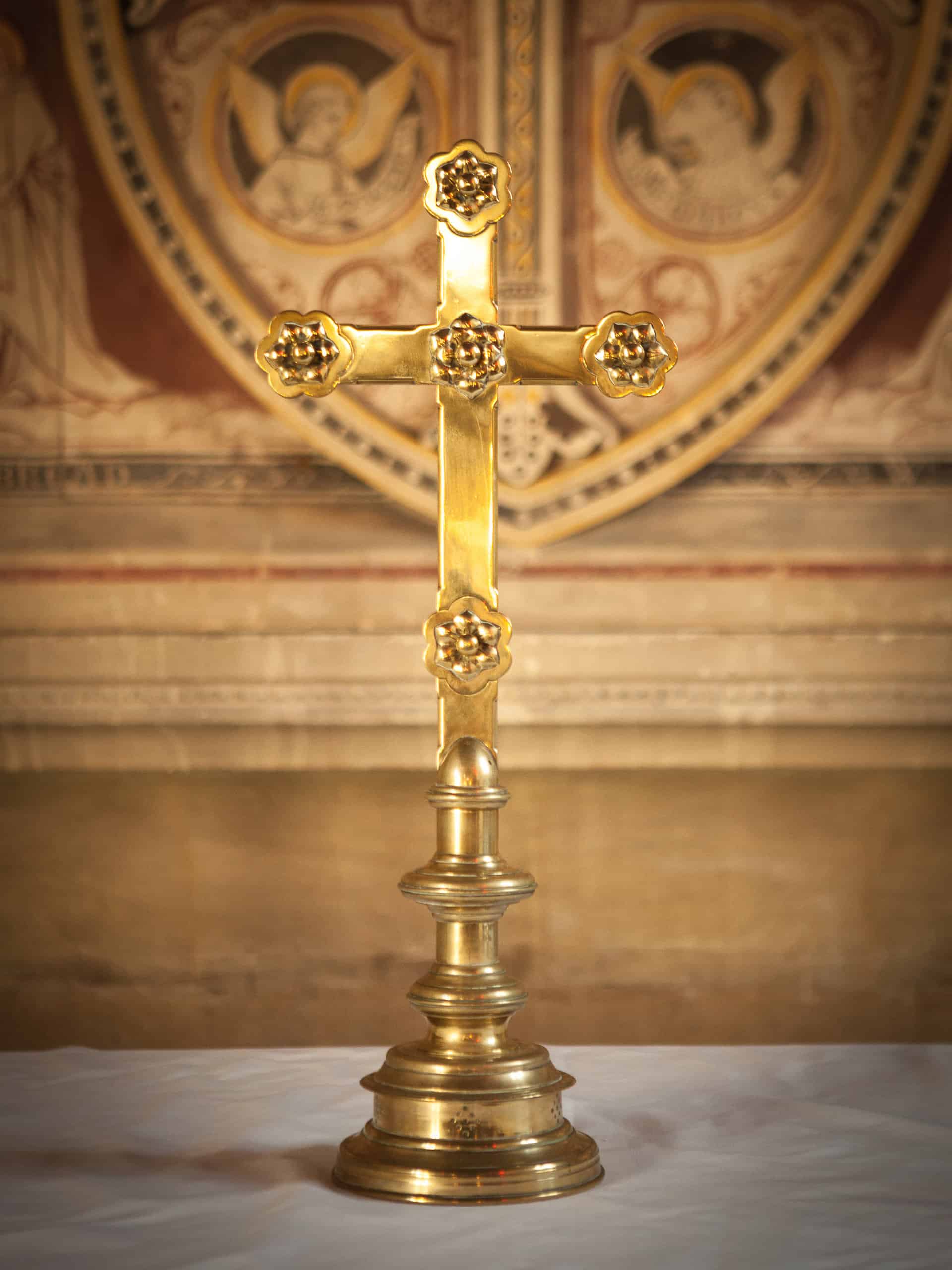
The north aisle has an early fourteenth-century window of three trefoiled lights with intersecting mullions. The chancel has three lancets at the east end, a pointed barrel roof of oak, a wrought-iron screen with brass candle sockets, and a wrought-iron pulpit.
The font
A fine octagonal font of the fifteenth century stands at the west end of the nave, with quatrefoiled panels on the bowl, leaf patterns, and trefoiled panels on the stem. One panel carries a shield with the arms of Incent.
The bells
Five bells. The treble was cast by Mears and Stainbank in 1874, the second by R. Wells in 1776. The third, of 1636, reads Praise the Lorde, and the fourth, of 1631, O be joyfull in the Lord.
Registers and patronage
The registers begin in 1538, the year parishes were first required to keep them, and run in four volumes, with gaps between 1625 and 1664 and again between 1705 and 1713. The advowson belonged to Richard de Wallop in 1342 and stayed with his descendants.
Architectural and historical detail on this page is drawn from A History of the County of Hampshire, volume 4, edited by William Page and published in 1911, through British History Online. Please send us more details or corrections if you have them.
Who to ask
- ChurchwardenJane Bedboroughchurchwarden@stpetersoverwallop.co.uk
- TreasurerJanet Baldockowpcctreasurer@gmail.com
- SecretaryHugo Deschampsneufssecretary@stpetersoverwallop.co.uk
- Electoral RollSally Bilesinfo@stpetersoverwallop.co.uk
- Tower CaptainJamie Biles
- OrganistStephen Baldockinfo@stpetersoverwallop.co.uk
- Church hall bookingsJanet Baldock07956 503073
- Churchyard and gravesStephen Baldockinfo@stpetersoverwallop.co.uk
The only church hall in the benefice, newly refurbished and available to hire at £10 an hour. Contact Janet Baldock for more information.
A toddler group in the church hall on Wednesdays in term time, from 9.30 to 11.30am.
Practice is on Wednesdays. Jamie Biles is Tower Captain, and learners are welcome.
Helen Porter (Lay Vice Chair), Ian Annett, Stephen Baldock, Jane Bedborough, Hugo Deschampsneufs, Jennie Loriston-Clarke, Mark Lovell and Ian Willis, chaired by the Rector.