When we meet
| Second Sunday | Morning PraiseGuitar and keyboard led, with hymns and worship songs. About 45 minutes. | 11.00am |
| Fourth Sunday | Holy Communion | 11.00am |
A few times a year, when a month has a fifth Sunday, the whole benefice gathers for one Communion, taking turns to host. See the whole month.
Gallery
More pictures from all six churches are in the benefice gallery.
About the church
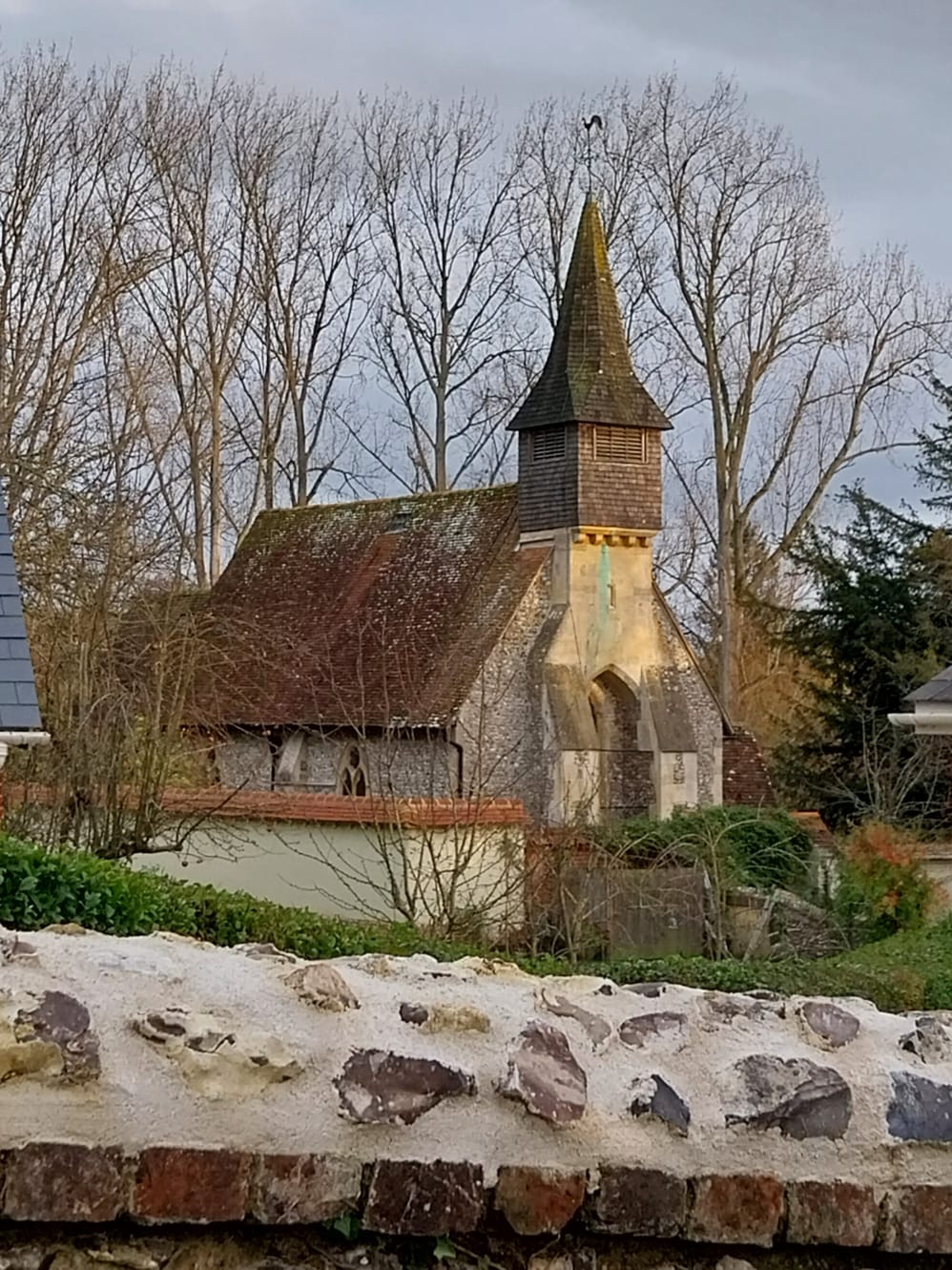
Tucked away among trees by Pill Hill Brook, St Mary's is a hidden gem, especially in springtime when the churchyard is a carpet of primroses and other wild flowers. With its shingle-faced belfry and broach spire perched on the gable, it was rebuilt in early Victorian times.
The present church was built of flint in 1853 to a design by Henry Woodyer (1816–1896), who specialised in English Gothic revival architecture. It was put up over the site of the earlier medieval parish church, and incorporates the two pillars and their capitals of about 1200 which had supported the chancel arch in the old building. Simple and beautiful inside, it is a much loved place of prayer.
Follow the winding path through the recently restored Memorial Gates, opposite the new Monxton and Amport Village Hall.
In more detail
The building
The church was rebuilt in flint and stone in the 1850s: a chancel about nineteen feet by twelve, with a vestry and organ to the north, a nave of forty-four feet by twenty, and a south porch. The bell-turret at the west end is wooden, with oak shingled sides and a small octagonal spire rising from a square roof, also shingled in oak.
Of the medieval church, only the twelfth-century capitals of the chancel arch survived the demolition, and they were built back into the new work.
Two brasses
Two brasses lie in the nave floor. One remembers Alice Swayne, who died in 1599 aged eighty-eight, shown in Elizabethan dress with a male figure beside her. The other carries a Latin inscription to Richard Pore, grandson of Adam Roberts, who died in 1606.
The bells and the plate
Two bells: one of 1669 inscribed T. W. Francis foster, the other cast by R. Wells of Aldbourne in 1783.
Among the plate is a pewter flagon given by Robert Hatchet, churchwarden, in 1682, alongside a silver chalice and paten cover of uncertain date and two pewter alms plates.
King's College, Cambridge
The patronage of Monxton has belonged to King's College, Cambridge since 1441, the year Henry VI founded the college. Nearly six centuries later it still does.
Architectural and historical detail on this page is drawn from A History of the County of Hampshire, volume 4, edited by William Page and published in 1911, through British History Online. Please send us more details or corrections if you have them.
Who to ask
- TreasurerRachelMonxtonTreasurer@gmail.com
- PCC SecretaryMrs Becky Williamsbeckymonxton.25@outlook.com
- MusicMr David Baugh, guitar, and Miss Charmian Howarth, keyboard
Opposite the new Monxton and Amport Village Hall: through the restored Memorial Gates, then along the winding path.