When we meet
| First Sunday | Holy Communion | 9.30am |
| Third Sunday | Morning WorshipWords, hymns and refreshments afterwards. About 45 minutes. Not Holy Communion. | 11.00am |
A few times a year, when a month has a fifth Sunday, the whole benefice gathers for one Communion, taking turns to host. See the whole month.
Gallery
More pictures from all six churches are in the benefice gallery.
About the church
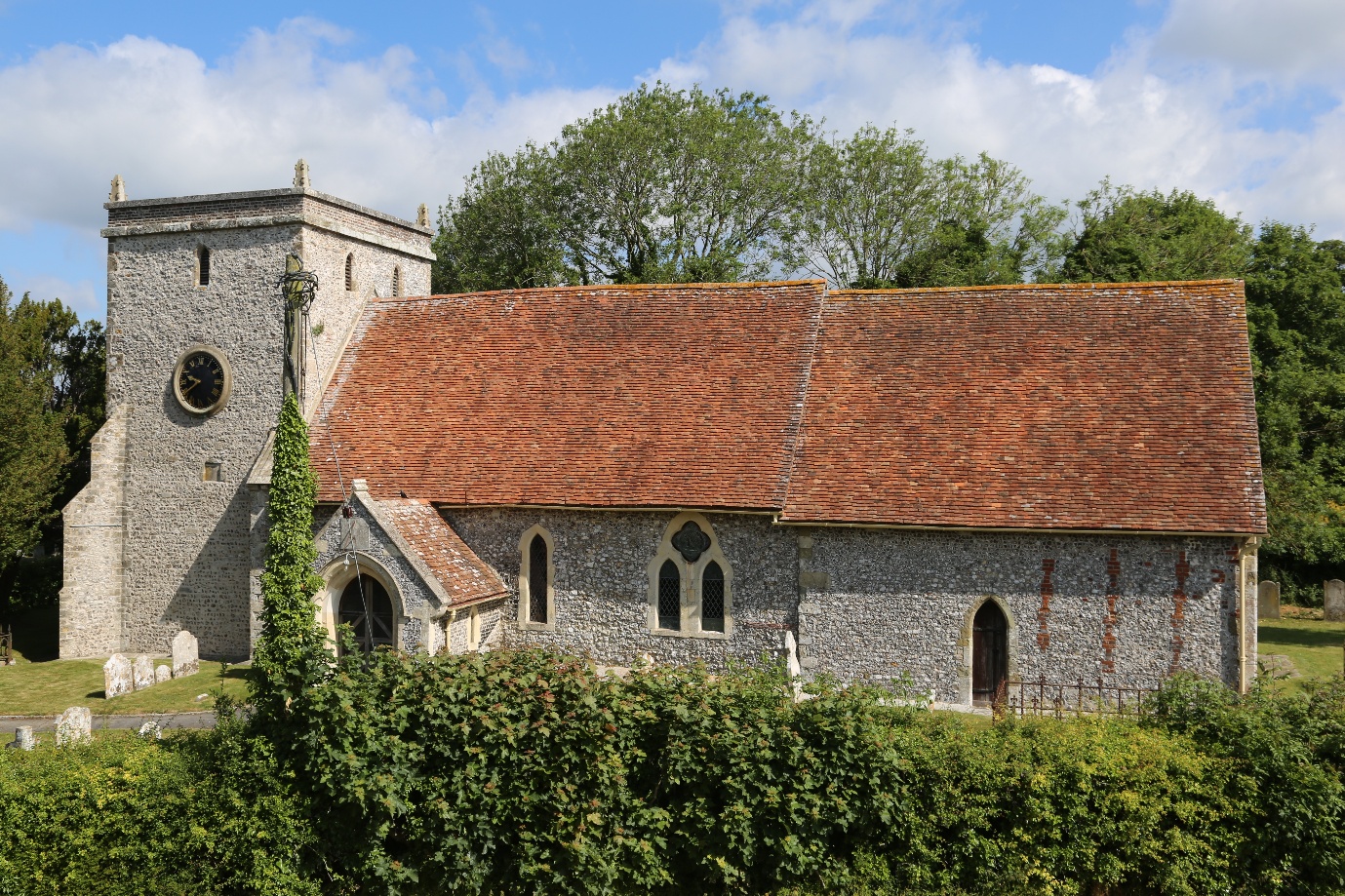
The beautiful church of St Leonard's is built on the location of a much older place of Christian worship, parts of which you can see in the building before you today. It carries Roman, Saxon and Early English elements together for those with a keen eye.
The nave is Norman with original features, the chancel thirteenth century, and the west tower thirteenth century with fifteenth century diagonal buttresses. The church was restored in 1851.
Its greatest treasure is the stained glass rescued from Salisbury Cathedral by William Benson Earle in 1787.
In more detail
King Athelstan's law code, made at Grateley
Some time around 926 to 930, King Athelstan, the grandson of Alfred the Great and the first king to rule all of England, held a great council at Grateley. What it issued is known to historians as the Grateley Code, or II Athelstan, and it is the longest and most detailed set of laws to survive from Anglo-Saxon England.
It is a remarkable document to have come out of a Hampshire village. It set a single coinage for the whole kingdom and named the towns permitted to mint it, with the number of moneyers each was allowed. It dealt with theft, with the keeping of oaths, with trial by ordeal, and with the duty of every man to have a lord answerable for him. Behind the severity of its punishments sits a recognisably modern idea: that one law, and one money, should run the length of a country.
The council would have met in the open air or in a royal hall, not in this building, which came later. But it met here, on this ground, and that is worth standing still for.
The building, part by part
Only the nave survives from the twelfth-century church. The chancel was rebuilt in the thirteenth century around a smaller earlier one, and the tower went up at the same time. The church was heavily restored in 1851, when the walls were refaced and new windows put in; the porch is modern.
Look for the small twelfth-century window with a semicircular head in the north wall of the nave, and the south doorway, partly of the same date, with chamfered jambs beneath a semicircular head.
The glass from Salisbury
Six fragments in the east window of the chancel, and a large medallion in a lozenge frame in the south-east window of the nave, were saved from the thirteenth-century glass that James Wyatt cleared out of Salisbury Cathedral. The grounds are deep blue with a yellow leaf pattern.
The medallion shows St Stephen, in alb, dalmatic and fanon, being stoned by two men, with the inscription stephs orans expirat: Stephen dies praying.
Joanna Elton's wish
A tombstone in the churchyard remembers Joanna Elton, who died in 1782 aged ninety-five. On the back of the stone are verses asking that flowers should always grow on her grave. Writing in 1911, the Victoria County History noted that her wish was still being carefully attended to.
The bells, the font, and a fire
Two bells, both cast by John Wallis of Salisbury in 1583, read God be praysed and God be our guyd.
The circular font was found at Manor Farm and brought back; its base appears to be the base of a cross from somewhere else entirely.
The registers begin in 1624, but everything before 1643 was written down from memory after a fire in that year. A note records that the wooden spire was half carried away by wind in 1781, repaired, and later removed altogether.
Architectural and historical detail on this page is drawn from A History of the County of Hampshire, volume 4, edited by William Page and published in 1911, through British History Online. Please send us more details or corrections if you have them.
Who to ask
- ChurchwardenMrs Juliet Wellsgrateleycw@gmail.com
- TreasurerMr John Normangrateleychurch@gmx.com
- PCC Secretarysophiebclifton@gmail.com
- OrganistMrs Suzanne Webber
We are a welcoming, lively and friendly church, and we enjoy fun, worship and fellowship together.