When we meet
| Second Sunday | Family Communion | 9.30am |
| Fourth Sunday | Family Service | 9.30am |
A few times a year, when a month has a fifth Sunday, the whole benefice gathers for one Communion, taking turns to host. See the whole month.
Gallery
More pictures from all six churches are in the benefice gallery.
About the church
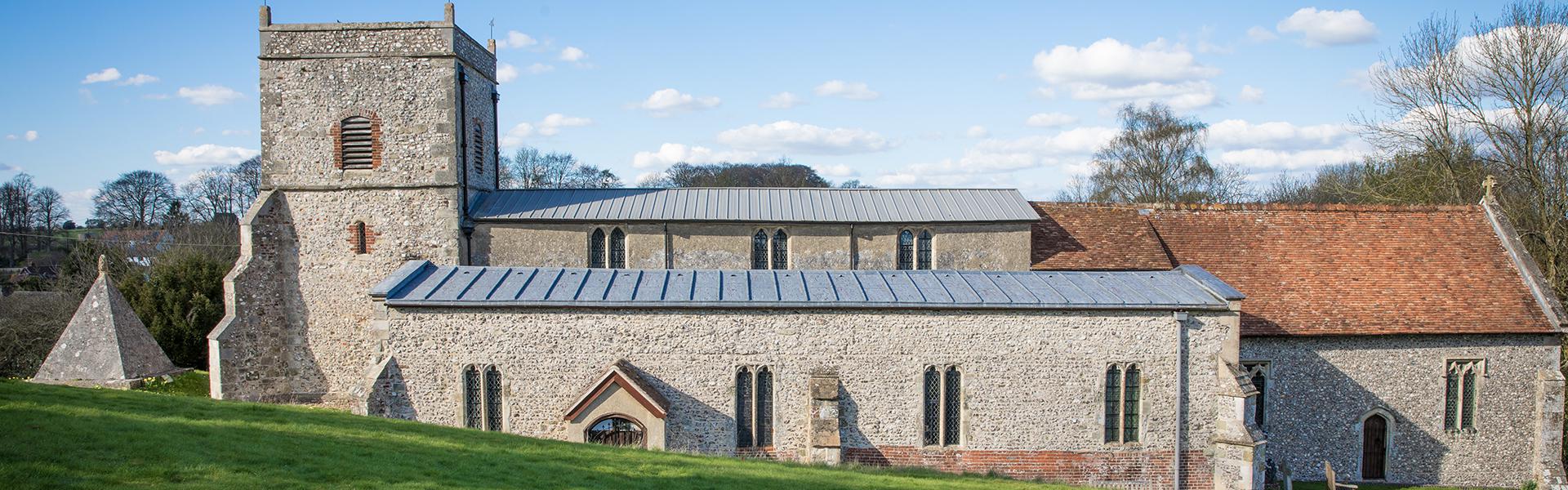
St Andrew's dates from the eleventh century, and Anglo-Saxon work is still discernible in its fabric. The walls carry some of the most important medieval wall murals in England, which is reason enough to enter, soak up the atmosphere, and spend a few minutes in quiet prayer, as generations of pilgrims have done before you.
The parish has been part of the Portway and Danebury Team Ministry since 2009. St Peter's Over Wallop, our sister church, alternates with us in the service pattern, so between the two there is somewhere to go on most Sundays of the month.
In more detail
The building, part by part
The church grew outward over six centuries. In the early twelfth century it was a small aisleless nave and chancel, about fifteen feet by eleven. A south aisle was added late in that century, and early in the thirteenth a north aisle went up, the nave was lengthened eastward, and the old chancel was pulled down and replaced. Both aisles were widened and extended in the fifteenth century, and the roofs of that date survive, with cambered and moulded ties.
The north aisle has a fifteenth-century window of three lights at either end, with image niches of the same date carrying pinnacled side shafts and projecting crocketed canopies.
The tower of 1704
The west tower was built in 1704, and a tablet inside records the people who did it: the churchwardens William Cleverly and John Leach, and the mason Thomas Muspratt, dated 1703.
Brasses and monuments
A worn brass slab in the north aisle commemorates Mary Gore, who died in 1437. At the east end of the same aisle is a fine brass casement showing a bishop or mitred abbot beneath a canopy, of the late fourteenth or early fifteenth century.
In the chancel floor is a slab to John Miller, 1647, and another to Esther Miller, who died in 1697 after a second marriage to Sir Henry Paulet, third son of the Marquess of Winchester. A slab to W. D. Clarke, described as late minister here, records his death in 1680 alongside his wife Susanna.
The bells
Five bells. The oldest, of 1585, was cast by John Wallis of Salisbury and reads Be meeke and loly to heare the word of God. Two more of 1642 read God be our guide and God is my hope. The fifth was cast by Clement Tozier in 1702.
A connection with York
For centuries this Hampshire parish answered to York. From the thirteenth century the Treasurer of York Cathedral, by arrangement with its dean and chapter, presented a rector here, who in turn presented a vicar. In 1291 the church was worth £66 13s. 4d. a year. Early in the fifteenth century the rectory was appropriated to the sub-chapter and vicars choral of York Cathedral, who have kept the advowson ever since.
Architectural and historical detail on this page is drawn from A History of the County of Hampshire, volume 4, edited by William Page and published in 1911, through British History Online. Please send us more details or corrections if you have them.
Who to ask
- ChurchwardenAlix Johnsonchurchwarden@standrewsnetherwallop.co.uk
- Hon. TreasurerJohn Waitstreasurer@standrewsnetherwallop.co.uk
- Hon. SecretaryJanet Herringsecretary@standrewsnetherwallop.co.uk
- Electoral Roll OfficerStephen Toddinfo@standrewsnetherwallop.co.uk
- OrganistStephen Baldock
- Fabric OfficerEmma Toddinfo@standrewsnetherwallop.co.uk
The church can be floodlit in memory of someone, or to mark an occasion, for £25 a month.
Nick Berry, Celia Grover, Sarah Sellick, Tim Toyne-Sewell and David Seal, alongside the officers above.