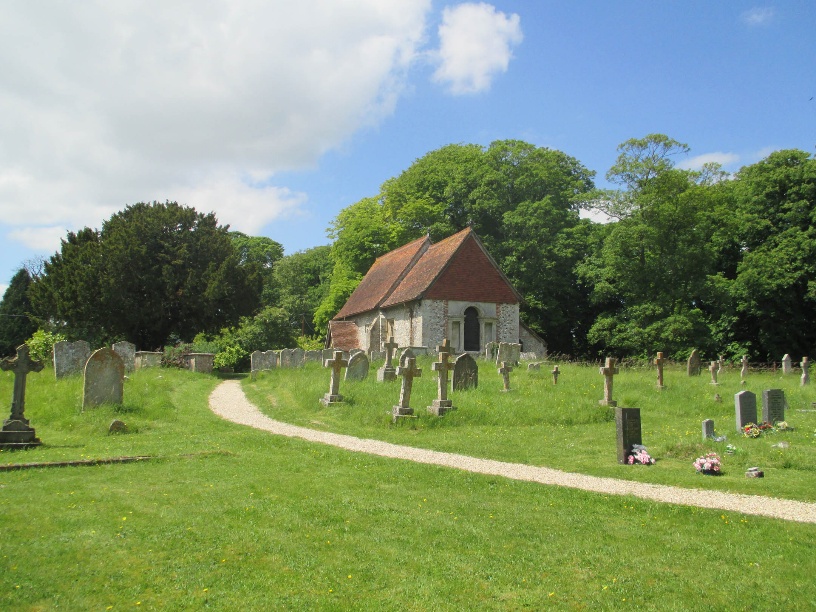
Our churchyards are peaceful, tranquil sites, and you are welcome in them at any time without asking anybody.
Burials and ashes
All six of our churchyards are open for burials and for the interment of ashes. Rights depend on the parish and on the space remaining, so it is worth asking early rather than assuming. See funerals for how to begin.
Memorials and headstones
Memorials are governed by the Diocese of Winchester's churchyard regulations, which set out permitted materials, shapes, sizes and inscriptions. Speak to the Rector or your monumental mason before ordering a stone, because one that does not comply cannot be erected and the cost falls on the family.
Finding a grave
At Over Wallop, Stephen Baldock keeps the churchyard records and will help you look. Elsewhere, ring the Rector.
What grows here
Churchyards are often the oldest undisturbed grassland in a parish. Never ploughed, never drained, never treated, and cut late: which is why they hold species that have vanished from the fields around them. If the grass looks long in May, that is on purpose.
The churchyard at Quarley is a Site of Importance for Nature Conservation, for its orchids and butterflies, with nature trails to follow. At Monxton, tucked among trees by Pill Hill Brook, the churchyard is a carpet of primroses and other wild flowers in springtime. Yew is the tree you will see most often, and some of ours are likely older than the buildings they stand beside.
Three stones worth finding
She died aged ninety-five. On the back of her stone are verses asking that flowers should always grow on her grave. Writing in 1911, the Victoria County History recorded that her wish was still being carefully attended to. It would be good to know whether it still is.
A pyramidal monument to Francis Dowse, who died in 1760, and Anne, who died in 1757, carrying the arms of Dowse impaling azure two bars or a canton erminois. A pyramid in a Hampshire churchyard is not something you see twice.
The oldest of a family group, and a reminder that a churchyard is mostly a record of the same few surnames, generation after generation, in the same soil.
Reading a churchyard
Stones face east, so the dead face the sunrise. The oldest are usually closest to the church and on the south side; the north was long thought a colder, less desirable place to lie. Lichen takes decades to establish, so a stone thick with it has been standing a long time undisturbed. And a stone that has sunk or leaned is not neglected; it is simply old ground doing what old ground does.
Six churchyards take a great deal of mowing, strimming and clearing, almost all of it done by volunteers. If you have an hour and a strimmer, you would be very welcome.